Saturday, December 2, 2017

Weekly blog 12/1/2017

https://upload.wikimedia.org/wikipedia/commons/9/91/Winkel_triple_projection_SW.jpg
Summary:
        Anything that you have had to be made somewhere like China, the USA, Taiwan, etc. With google my maps you can mark where each of your thing you get and connect them to have a visual to show where the product had to travel. Knowing where your products come from may not seem important but your carbon footprint is. A carbon footprint is the amount of carbon a person leaves behind like fossil fuels. It is important to know how much carbon you are putting in the environment because we want to always make sure we are helping to save our environment. You want to buy things that are more local so that you do not leave as much carbon behind and so that you are doing your best to preserve the environment.


SP2: Developing and using models
        Using My Maps to create an interactive map my partner and I for charity fair made a model showing where our products were made and we also created lines showing where everything that we used traveled. We had to color coat things to show how they traveled like if they traveled by plane truck, car, train, etc. We had to make find the manufacturing address of all of our products to find where they are made. We had to also calculate our carbon footprint by guessing if it traveled by car, truck, plane or train so that we would know how much carbon we were leaving and how we are impacting the environment. In the end this was worth it and was a very cool and good visual.


Friday, November 10, 2017

Weekly blog (biological classification)

https://swh-826d.kxcdn.com/wp-content/uploads/2010/12/cladogram.gif
Summary:
        A cladogram is something that is used to classify animals and show how they are related, it is like a family tree or a tree of life. A tetra-pod is an animal that has 4 limbs with movable muscles and joints. Humans would be technically considered tetra-pods because we have 4 limbs, joint's and muscles. The picture above is a cladogram and is is showing that similarities that animals have like how crocodiles and birds have eggs with shells and how rodent's, rabbits and primates have hair. Everything has a vertebrae in the picture and a vertebrae is very important because it has lots of nerves and things connect and send signals to your brain. Every part that an animal has is useful and important to what that animal does and where they live.

SP 2: Developing and using models:
        I had to use a cladogram to find my information and to find the similarities and differences in animals. We also read a google presentation about who first classified animals in a organized manner. There are lots of different animals and ways to classify them like with a cladogram to find the traits that match with different animals and connect them to a common ancestor. With a cladogram you can organize by finding what is a fungi, mammal, green plant, and more by finding what makes something put in a category like if something gives live births and needs to breathe air it is most likely a mammal. There are lots of different ways to organize animals and one of the ways is by using a cladogram.

Saturday, November 4, 2017

Weekly blog (bone structure)

http://kylehallnationaltrust.weebly.com/uploads/2/4/3/7/24374307/4139762_orig.jpg
Summary:
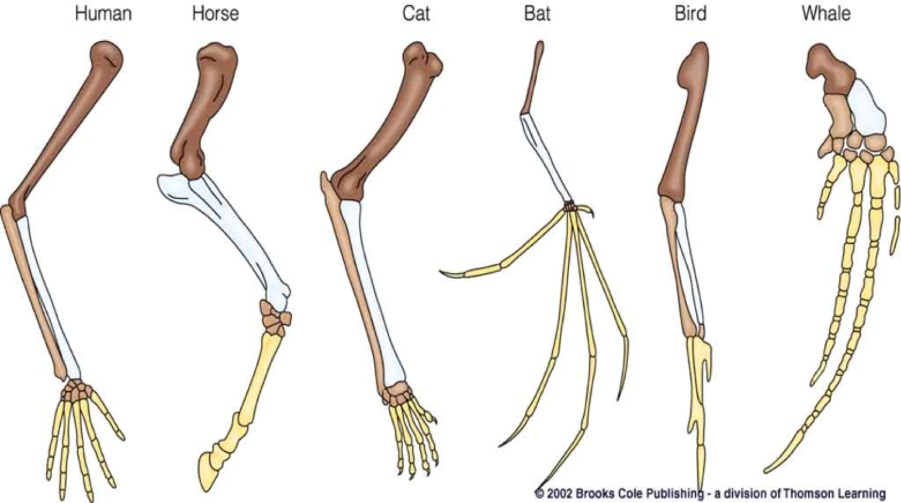
        Comparative analogy is when scientists compare different animals bone structure and their anatomy to see the similarities and differences. This is is something that shows things like common ancestors and it shows how closely related one animal is to another. The picture is showing how what the different bones are in animals and each color shows each part of the different animals like how humans and cats have fingers and a bat has longer finger type bones, while horses have a hoof, and more. In the picture the cat's arm looks closest to the human arm then anything else and that is showing how humans and cats are the closest to each other and could have a common ancestor. This is something that is to find the common an ancestors of animals and it is something to see how things are related.

SP 4: Analyzing and interpreting data:
        We made a graph this week to observe the similarities and differences in animals like T-Rex's and if they were extinct or things we would use the comparative analysis. We had to add a + or a - to show if the animal did or did not have a certain feature like hair and things but if we did not know like how we do not know if the T-Rex had hair we would put a question mark. The graph was to show the similarities and differences between animals. We also looked at the arm bones of different animals and color coated the bones to see what the bones were in one animal vs another. We did lots of different visuals and analysis of animals to find the similarities and differences.

Saturday, October 28, 2017

Peppered moth's Weekly Blog

https://upload.wikimedia.org/wikipedia/commons/7/76/Peppered_Moth._Biston_betularia_2_-_Flickr_-_gailhampshire.jpg


Summary:
A peppered moth is a moth that can be all black or is can be with with spots of black. The multi colored moths like on tree’s with light bark like birch tree’s and there is a thing called lichen (a fungus that can grow on trees) that the moth’s also blend well into. The black moth’s will usually live in a darker area and this is something that can help them to camouflage better than with the light tree’s. The moth’s are all nocturnal which also helps them to avoid predators that may hunt during the day. Flying around in the night also makes it so that it is harder for predators to spot them and makes sure that they can survive better. Their predators are birds like flycatchers, European robin, nuthatches, etc.


SP:3
To help illustrate the peppered moth’s example we played a game where the player would act as a bird and you would try to eat as many peppered moth’s as you can in a minute. You could chose if you wanted to play in a dark or light forest and there would be 50% dark moths and 50% light. Depending on which one you choose it will be easier to see the moth’s that stand out rather than the moths that blend in with the environment. In the end you would see which of the two there were more of and it would tell you why. This was something that was interesting to play and to see what it would be like in a bird's view to have to catch the moths.

Friday, October 20, 2017

Weekly blog evolution

https://upload.wikimedia.org/wikipedia/commons/1/1d/Anatomy_and_physiology_of_animals_Various_vertebrate_limbs.jpg
Summary: 
        Evolution is when a species develops certain traits to live better in the certain environment it is in so when you look at certain animals from one environment it is. Evolution is the thing that made creatures look, like how people think that animals have a common ancestor, humans evolved from apes and things. The diagram or picture above is to show the similarities in arm bones off different animals vs. human, you can see that some look more similar then others and they all have the same function and this is showing proof of common ancestors. When something has a similar function to another in a different animals like arms, legs, eyes, noses, teeth, etc. it is called a Homologous structure.

SP3: Planning and carrying out investigations:
        This week we did a experiment where we would take a fork spoon or knife and some buttons and beans. Then we would have a timer for 20 seconds and we would have to pick up as much as we can with our tool, and if we had 20 or more we would stay alive but if you got under you went extinct. When you get extinct you get replaced and this was to show how in natural selection it is more random and it is something that is chosen based on their fitness in the environment. This experiment was something that helped as a visual and an example and it was something that seems fun to do with more friends.

Sunday, October 15, 2017

Weekly blog 9/15/17 mutations

https://upload.wikimedia.org/wikipedia/commons/thumb/6/65/DNA_com_GGN.jpg/1280px-DNA_com_GGN.jpg

Summary:
        There are many kinds of mutations and most of the time they do not affect the look or anything about the organism. The bases are A, T, C and G, A is always paired with T and C is always paired with G. You can have insertions, deletions or substitution. An insertion is when you have an extra base added to your DNA, deletion is when you take away a base, and substitution is when you have the wrong base with the wrong base. Not all mutations are hidden and not shown by the person with it but in rare cases it  can help or harm the person.

SP3: Planning and carrying out investigations:
       This week we did a lab where we investigated mutations and how they survive. We got M&M's and tic-tac's, the tic tac's were the mutation and we had to have 5 of them mixed in with the 12 other M&M's. We had to blindly remove 5 each time and replace it with whatever we thought made sense according to our population. We were observing how mutations survive and what mutations would be good and bad. This ended up being a good and fun way to learn and represent mutation. We had a good visual of the tic- tac' and the M&M's to represent mutations.

Saturday, October 7, 2017

Project Blog Geologic time scale

https://upload.wikimedia.org/wikipedia/en/6/6e/Geologic_time_and_mass_extinctions.png
Summary:
The Paleozoic era was a time that had 6 different time periods in it called the Cambrian, Ordovician, Silurian, Devonian, Carboniferous, and the Permian time periods. Some interesting things about this era is that the continents had shallow water covering them, larger animals like 5.9 foot centipedes and things. In this time it had lots of marine life and the first jawed fish and the fish had certain body shapes and things for special tasks and fins for better swimming. There were 3 major mass extinctions, one of them was in the Ordovician time and the Silurian time where lots of the marine life was killed and reduced in numbers. Another one is in the late Devonian time 3/4 of life on earth died and it was not necessarily all at one time, it could have been over several years. The last mass extinction was the Permian mass extinction or the Great Dying where 96% of species went extinct and the 4% left is what all current life is descended from.  There were lots of crazy things that happened in this time that would be hard to imagine happening now.

Backward-looking: How much did you know about the subject before we started? 
I knew some basics about the dinosaurs that lived in the Mesozoic era and things like the meteor's but I did not know anything about the Paleozoic time or what it was. I have learned a lot of things from this project and I did not have any background on my era because I did not know about it. I am slightly happy that I did not know anything about it because it has taught me a lot and it is something that helped to keep me interested in it and something that was more fun and surprising. I did not know much so it was something that made me think more and was something that was cool and different to learn about. I did not know anything about this but it turned out fun and well in the end of it and I am happy with how it turned out.

Inward-looking: How do you feel about this piece of work? What parts of it do you particularly like? Dislike? Why? What did/do you enjoy about this piece or work?
I think that this project was a great and fun project and it was not too long for time and not too short of time and I think that it was one of my favorites. I like this project because it had lots of creativity and flexibility to the end product like how we could make it with flaps, 3-D, a poster, diorama and more but it was definitely fun. I liked almost everything but it was hard because our team would argue and it would create more stress for the project and getting it done. I think that I would love to do more projects like this because it had lots of flexibility because everyone's was unique and it was fun getting to come up with and be creative. Overall this was one of my favorite projects and I would love to do more like it.

Outward-looking: Did you do your work the way other people did theirs? In what ways did you do it differently? In what ways was your work or process similar? 
Ours was different then everyone else's because we had the giant flap for each era and the small flaps on the inside and even when people did flaps they did not have a giant flap with smaller ones inside. Every groups was unique and In some ways it was similar because we all had the same base with the information about the era's but everyone wrote different things even if it seemed similar. The process was that we had to do the research and that we had to create the project in the end. This process was similar to everyone else's and we all did things around the same time but it always ended up different. Everyone did a great job and everyone made theirs different and unique which I liked.

Forward-looking: What would you change if you had a chance to do this piece over again?
If I did this again I would make it so that we would have done a little bit more at our house or met up after school so that we would have had extra time to add more drawings. I think that we did pretty well and I am happy about the end result of our project. I would want to do another project in a similar manner with the fact that the project was flexible for everyone to make something different. I think that our project looks great and even if we wanted to change anything it is done now and I am happy that we have it done and I am happy that our whole group was happy. Everyone did equal work which was nice and no one had to do someone else part and when it came to supplies we did not have to by much and some of the stuff our team already had or we used from the maker lab. I would not want to change much but it is over now and it was a great project that I would like to have another project done in the same matter.